Skip to content

How Water Affects the Taste of Coffee


You may be surprised to learn that water is one of the most important factors in how coffee tastes. This post will explore this critical element and give you some tips on how to make your coffee taste better.

The post goes on to discuss water's impact on flavor, how it affects different coffees, and what type of water makes a good cup of joe!

How Water Affects the Taste of Coffee

How Water Affects the Taste of Coffee

Coffee is often served with milk, cream, or sugar. Most people don't think about the water used to brew coffee as affecting the taste of their morning cup of joe.

However, after tasting some truly amazing cups of coffee made using different types and qualities of water, I was convinced that there's no other way to explain it than by saying that water does affect the flavor!

The reason for this may be due in part to the minerals present in your tap water or because you're boiling your kettle so much more diligently than before. Regardless, what's important is enjoying all the nuances and flavors available in a delicious cup o' joe.

What pH of water is best for coffee?

If you love coffee as much as I do, you've probably wondered what the best pH for brewing coffee is.

In order to brew great-tasting java, you need water that is appropriate for coffee. Water that is too hard or alkaline will extract extra bitter compounds from the ground coffee, resulting in a bad-tasting beverage.

On the other hand, water that is too soft or acidic can lead to poor extraction of soluble flavor compounds, resulting in a weak and underdeveloped cup.

what type of water to brew coffee?

Quite literally speaking, this means you should aim for water with a pH in the range of 6.5–7.5 when brewing your coffee, and this is usually achieved through the use of neutral or slightly alkaline spring water.

In addition to being appropriate for taste, this range is also appropriate from the point of view of acidity and base, which play an important role in extracting key constituents from ground coffee.

This means you should view an appropriate pH for brewing as an important consideration when choosing your water source, even if it is just for home use.

Different water types for coffee

When it comes to coffee, the quality of the water used in the process is just as important as the quality of the beans. The mineral content, acidity level, and even its source are all factors that will have an impact on the final result.

Many expert baristas say that good-tasting water will make good-tasting coffee, while bad-tasting water will make bad-tasting coffee, no matter how well roasted or fresh the beans are.

The following is a list of the most common water types and how they pair with coffee. I’ve put this list together to explain their differences and make some suggestions on which one is best for your morning brew:

Tap Water

While pure H2O may seem like an obvious solution to better-tasting coffee, it's important to remember that what you're drinking isn't just H2O anymore. Tap water has various dissolved minerals that will affect your cup one way or another depending on its concentration level.

Some experts swear by using distilled water as the only acceptable option, but even this no longer guarantees a neutral beverage since many distillers actually make water more aggressive by stripping it of its natural mineral content before bottling it.

Hard Water

This water type will create a great cup of espresso without scaling up your equipment or imparting any undesirable flavors. The downside is that it's a little less versatile and isn't recommended for brewing all coffees, especially those with lighter roasts, since this water type tends to accentuate the fruitier notes that are usually desired only in darker roasts.

Soft Water

This water type will yield a very tasty cup of espresso, but its low mineral content makes it ill-suited to use when brewing darker roasts. Soft waters also tend to strip the naturally occurring oils from coffee grinds faster than harder types, which release them more easily into your cup.

City Water

City water typically contains elevated levels of chlorine, which should be deactivated using a carbon filter. The downside of city water is that it contains trace amounts of every conceivable kind of pollutant, which you really don't want to be drinking in the first place, let alone through your coffee maker, but we realize this isn't practical for everyone.

best type of water to brew on coffee

Carbon Filtered Tap Water

This option will give you the best balance between flavor and convenience, without any mineral buildup. We recommend all our customers use this type of water when possible for their personal at-home coffee-making needs.

Distilled or Reverse Osmosis Water

These options will yield the purest flavor with no mineral content whatsoever, but they are also the most expensive. They should only be used if absolutely necessary (i.e., when traveling) and can often be found in high-end specialty coffee shops to make brewed coffee.

Soft water vs. Hard water

I decided to get a little more technical about this with you, in case you are wondering how to recognize soft vs. hard water.

Water hardness is an important chemical property of water. It refers to the calcium and magnesium salts in water. These are naturally occurring substances in our drinking water sources that can have a significant effect on human health.

Hardness is usually expressed in ppm (i.e., parts per million) or ppm (i.e., milligrams per liter or parts per million). The ppm value indicates the content of calcium carbonate (CaCO3) in water; 1 ppm means that there is one milligram of calcium carbonate per liter of water (1 ppm = 1 mg/L = 0.0051 g/gal).

Water is categorized as "hard" when the ppm value is above 120, "moderately hard" when 60 ppm to 120 ppm, and "soft" at below 60 ppm. Look at the label for these numbers when you are purchasing water to brew your coffee! 

Final Thoughts

At the end of the day, it's not about what kind of coffee you drink or how much caffeine is in your cup. It's all about where that water came from and what minerals are flowing through it.

So pick up a bottle today to find out if one type tastes better than another. Experimenting is always the best way to find out! Happy Brewing!

FAQs about Water and Coffee Taste

How much does water actually matter for coffee taste?

Coffee is 98%+ water — so water is most of what you taste. Bad water = bad coffee, full stop. Most home coffee tastes "off" because of water mineral content, not the beans. Even a $30 bag of specialty beans like our Anniversary Edition will taste mediocre with poor water.

What kind of water is ideal for coffee?

SCA standard: 150 ppm total dissolved solids, balanced calcium and magnesium, low chlorine. Most filtered tap water is close enough. Avoid distilled water (no minerals = no extraction) and most bottled spring waters (often too hard). A simple Brita-filtered tap water is usually a 90% solution.

Why does my coffee taste bitter even with good beans?

Two suspects: water that’s too hot (above 205°F) or water that’s too hard (high mineral content over-extracts). If your tap water tastes mineral-heavy or leaves white scale, run it through a Brita or use bottled spring water with 150 ppm. Pair with a fresh roast like Asa Tsuyu to eliminate other variables.

Is there a "perfect coffee water" you can buy?

Yes — Third Wave Water and similar products sell mineral packets you add to distilled water for SCA-spec brewing. They’re excellent but pricey if you brew daily. For most drinkers, filtered tap water is the practical answer. The mineral packets are nice for special tasting sessions.

Does water temperature matter as much as mineral content?

Almost. 195–205°F is the brewing sweet spot. Below extracts sour and weak; above extracts bitter and harsh. Get this right and the mineral content is the next variable to tune. Both are bigger factors than the brand of beans for most home setups. Read our grinding piece for the third major variable.

How Grinding Affects the Taste of Coffee

Related products

3 reviews

Asa Tsuyu Blend [Light Blend] (Colombia, Brazil, Ethiopia)

USD $25.00 USD $19.99
Quick view

Delicate, invigorating, and oh so pure! This blend knows how to dish up a warm welcome. Our lightest blend features beans from Columbia, Brazil, and Ethiopia. We’ve found that this roast makes an incredible espresso, as well as a beautiful, bright drip coffee. With pure coffee flavor, soft touch of sourness and a rich sweet aroma —this light blend helps you start the day off right.

5 reviews

Decaf Premium Blend (Colombia, Brazil, Ethiopia)

USD $35.00
Quick view

The secret behind Sapporo Coffee Kan’s original Caffeine-off blend lies in a groundbreaking German method called the "Liquid Dicarboxylic Acid Extraction Method," which removes 93–98% of caffeine while preserving the coffee’s original flavor, aroma, and richness. Unlike conventional decaf processes that strip away essential taste components, this technique uses a careful combination of low pressure and temperature over an extended period, ensuring the coffee’s delicious character remains intact. The beans are then roasted using Sapporo Coffee Kan’s unique CSR (Charcoal Straight Roasting) method, minimizing oxidation and preserving the coffee’s vibrant profile. As a result, this decaf coffee is so flavorful and satisfying that it is served at high-end restaurants with evening desserts, offering a true specialty coffee experience for caffeine-sensitive individuals, pregnant women, nursing mothers, and anyone advised to reduce caffeine intake.

16 reviews

Hokkaido Blend (Colombia, Brazil, Honduras, Indonesia)

USD $25.00
Quick view

Sapporo Coffee Kan's most popular and long-selling signature blend, known as "the house blend," offers a rich, full-bodied coffee experience with a pleasant, mild bitterness and a mellow taste. Crafted by adding the finest Mandheling Berkat Lingtong beans to the blend, it achieves a rare balance—delivering depth and complexity without the sharp acidity often found in other coffees. For those who prefer a smoother, less acidic cup without sacrificing richness and flavor, this special house blend truly hits the spot.

5 reviews

Select Blend Combination Set (Get 30% Off)

USD $110.00 USD $77.00
Quick view

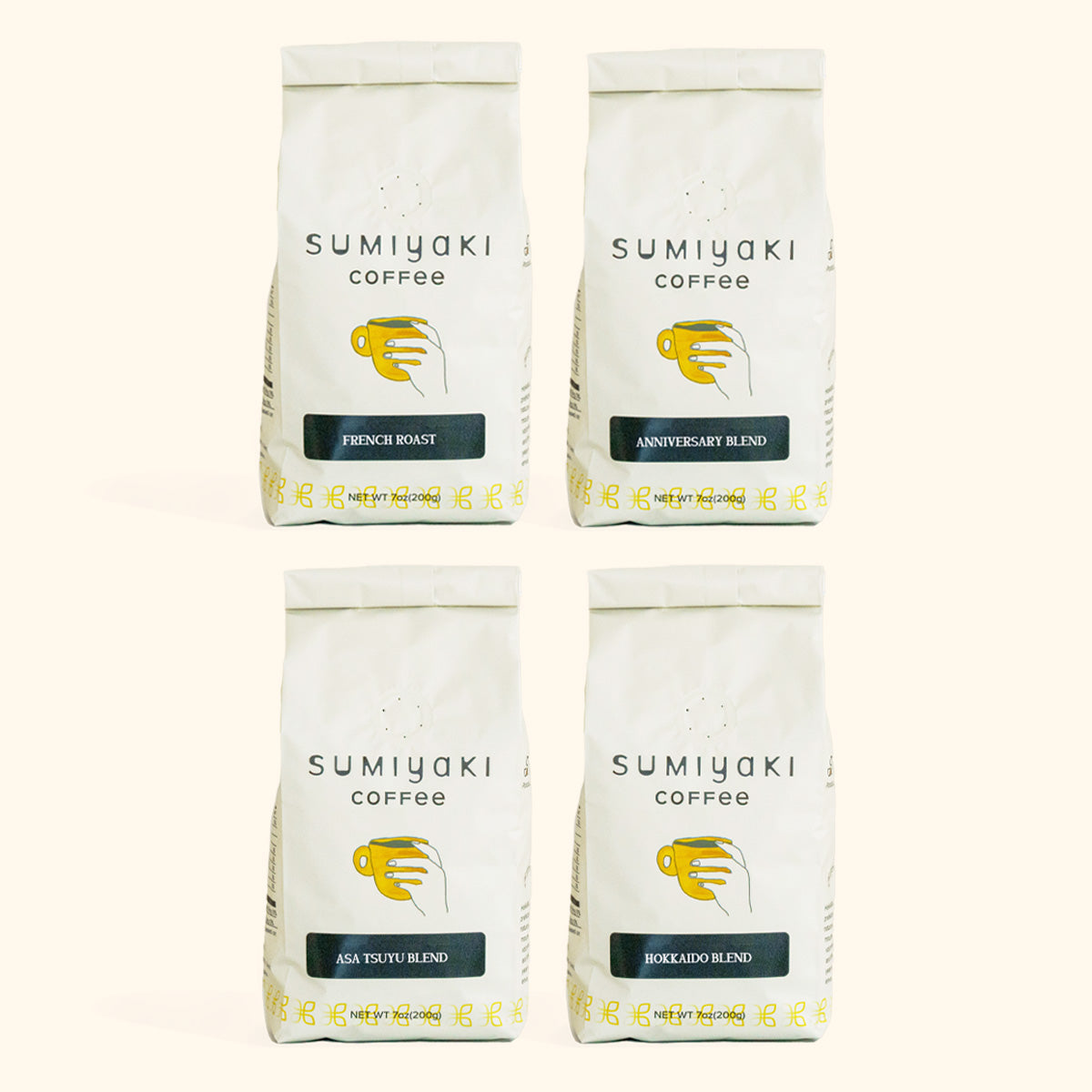
Get 30% off for a limited time when you purchase this special Combination Set featuring four of our most popular Premium Blend Sumiyaki Coffees. Your order will include four 200g packages: Anniversary Blend Coffee (Colombia, Brazil, Indonesia), the fruity favorite originally created for Sapporo Coffee Kan’s 30th anniversary; Asa Kiri Blend, a light roast with pure coffee flavor and a soft touch of sourness; Hokkaido Blend, the signature house blend beloved for its rich and balanced taste; and French Roast Blend, a dark, smoky roast perfect for pairing with milk or crafting café au lait and coffee cocktails. All beans are roasted to order under the expert blending tradition of Sapporo Coffee Kan, led by Ito Eiichi, the renowned “King of Blenders” in Japan, ensuring every cup is a masterful balance of flavor and aroma.

Asa-Yuu Blend Duo (Get 20% Off)

USD $50.00 USD $39.00
Quick view

Meet the Asa-Yuu Blend Duo (朝夕): a roasted-to-order set featuring Asa Tsuyu (light roast, Colombia/Brazil/Ethiopia) and Hokkaido (medium roast, Colombia/Brazil/Honduras/Indonesia). Bright in the morning, smooth and balanced through the day—now 20% off for a limited time.


Related Articles You May Be Interested

Can a coffee pot make the coffee taste better?
How Climate Affects the Taste of Coffee
Does the Type of Mug or Glass Affect How Coffee Tastes? – Coffee Quiz
How Roasting Affects Taste of Coffee
Coffee Flavor Terminology - Everything You Need to Know

Get Free Bonus Books

Join Japanese Coffee Club

Sign up for free to the Coffee Club to get advice and exclusive articles about how to choose Japanese Coffee, and tips, tricks, and recipes for enjoying Japanese coffee.

Unsubscribe anytime. It’s free!

About the author

Kei Nishida

Kei Nishida

Author, CEO Dream of Japan

info@japaneseCoffeeCo.com

Certifications: PMP, BS in Computer Science

Education: Western Washington University

Kei Nishida is a passionate Japanese tea and coffee connoisseur, writer, and the founder and CEO of Japanese Coffee Co. and Japanese Green Tea Co., both part of Dream of Japan.

His journey began with a mission to introduce the world to the unparalleled quality of Japanese green tea. Through Japanese Green Tea Co., he established the only company that sources premium tea grown in nutrient-rich sugarcane soil—an innovation that led to multiple Global Tea Champion awards.

Building on this success and his passion for Japanese craftsmanship, Kei expanded into the world of coffee, pioneering the launch of Japanese Coffee Co., the first company to bring Sumiyaki charcoal-roasted coffee to a global audience. His dedication to authenticity and quality ensures that this traditional Japanese roasting method, once a well-kept secret, is now enjoyed worldwide.

Beyond tea and coffee, Kei has also introduced Japan’s legendary craftsmanship to the world through Japanese Knife Co., making handmade katana-style knives—crafted by a renowned katana maker—available outside Japan for the first time.

Kei’s journey continues as he seeks out and shares the hidden treasures of Japan, one cup and one blade at a time.

Related Posts

Balmuda Brings Japanese Lifestyle to Brooklyn – My First-Hand Journey at Cibone O’te

Step into Brooklyn’s ‘Little Tokyo’ where timeless Japanese craftsmanship meets sleek innovation—dashi, design, and dram

Read More
Exciting News: We Acquired the History of Katana YouTube Channel!

Welcome to the famed History of Katana YouTube Channel—unlocking rare stories, epic blades, and what comes next. Curious

Read More
Mikado Coffee: A Timeless Brew With a Legacy in Japan
Mikado Coffee: A Timeless Coffee With a Tradition in Japan - Cafe Spotlight

Is Mikado just another café—or the soul of Japan’s coffee culture? Step inside and uncover the rich legacy brewed into e

Read More
Leave a comment

Your email address will not be published..

Cart

Your cart is currently empty.

Start Shopping

Select options